

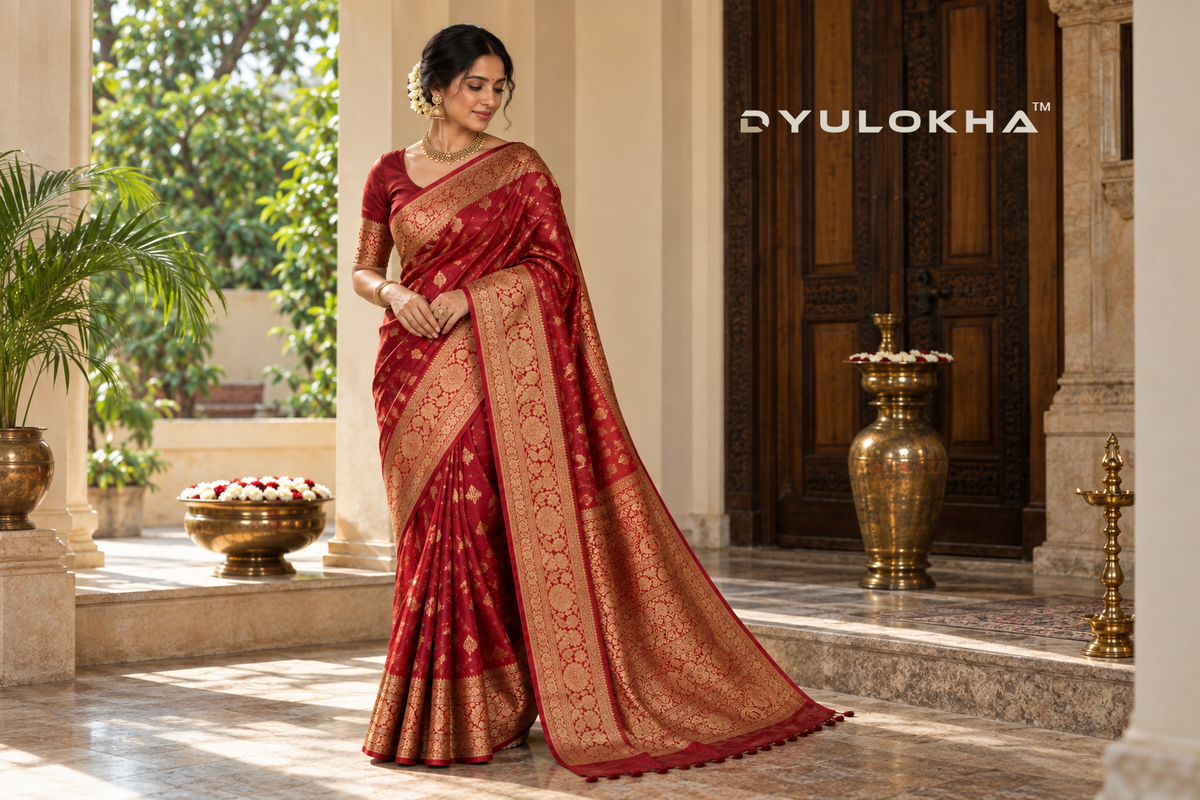
The Complete Banarasi Silk Saree Guide: Types, Zari Work, Real vs Fake, and How to Style
By Aditi Sharma, Editor of Bridal and Ethnic Fashion
The Banarasi silk saree is India's most storied weave. Woven in Varanasi for over 500 years, its heavy zari work, precise motifs, and Persian-influenced patterns have made it the bridal saree of choice across North India and, increasingly, across the world. But not every saree called Banarasi is really Banarasi. Machine-made replicas, chemical-dyed lookalikes, and false-zari imitations flood the market. Even legitimate Banarasis vary widely: some are Katan pure silk, others Organza, others Georgette. Knowing what you're buying (and what you're paying for) is the difference between an heirloom and a disappointment. This guide walks through the types of Banarasi sarees, how to spot real handwoven work from replicas, current price ranges in 2026, and how to style Banarasi sarees for weddings, receptions, and beyond.
What makes a saree Banarasi?
Three things.
Origin: true Banarasi silk sarees are woven in and around Varanasi (Banaras) in Uttar Pradesh. The weaving tradition dates back to the Mughal period, when Persian craftsmen brought floral motifs and zari techniques that fused with existing Indian weaving.
Weave technique: Banarasi sarees are handwoven on wooden pit looms, with a single saree taking anywhere from 15 days to 6 months depending on the intricacy of the pattern. The zari (metallic thread) is added throughout the weave, not embroidered on top later.
Motifs: classic Banarasi motifs include the paisley (kalka), floral bouquets (buta), mango patterns, jhalar (fringe patterns), and the distinctive kadhwa (extra weft) technique that creates raised patterns across the body of the saree.
If any of these three is missing, what you're holding may still be a beautiful saree, but it isn't a real Banarasi.
The 4 main types of Banarasi silk sarees
Not all Banarasis are the same. The base fabric changes the drape, price, occasion, and durability significantly.
1. Katan Banarasi (Pure Silk)
What it is: The traditional and highest-grade Banarasi. Woven with pure Katan silk threads (twisted silk yarn from mulberry silkworms). Heavy body, structured drape, holds shape brilliantly.
Best for: Weddings, receptions, muhurtham, heavy formal occasions.
Price range in 2026: ₹15,000 to ₹1,50,000+ for handloom Katan Banarasis. Museum-grade Katans with pure gold or silver zari can go into ₹3,00,000+ territory.
How it drapes: Structured, holds pleats sharply, doesn't cling. Feels weighty, luxurious.
Care: Dry clean only. Store folded in muslin cloth with dried neem leaves.
2. Organza Banarasi (Kora)
What it is: Woven with organza silk (a lightweight, transparent silk). Same Banarasi weaving techniques and motifs, but far lighter fabric.
Best for: Sangeet, mehndi, cocktail functions, summer weddings, receptions.
Price range in 2026: ₹8,000 to ₹60,000 for handloom Organza Banarasis.
How it drapes: Fluid, floats around the body, slight sheer quality. Elegant and modern.
Care: Dry clean only. Gentle handling, no folding for long periods (leaves creases in organza).
3. Georgette Banarasi
What it is: Silk georgette base with Banarasi weaving. The georgette gives fluidity and modern appeal. Lighter than Katan, more structured than Organza.
Best for: Receptions, engagement parties, festivals, upmarket casual events.
Price range in 2026: ₹6,000 to ₹35,000 for handloom Georgette Banarasis.
How it drapes: Flowy, easy to carry, doesn't feel heavy for long-wear occasions.
Care: Dry clean only. Store hung with care, avoid metal hangers.
4. Shattir and Tanchoi Banarasi
What it is: Speciality Banarasi weaves. Shattir is a mixed-fibre Banarasi (silk + rayon or cotton) that's more affordable. Tanchoi is a highly patterned Banarasi with dense repeat motifs, often without a distinct border-and-pallu structure.
Best for: Shattir works for daily-formal or festival wear. Tanchoi is for connoisseurs who value pattern density.
Price range in 2026: Shattir Banarasis ₹3,000-₹15,000. Tanchoi Banarasis ₹15,000-₹75,000+.
Understanding the zari: this is where most people get fooled
Zari is the metallic thread that makes Banarasi sarees look regal. The type of zari used determines the saree's value, appearance, longevity, and authenticity claims.
Real zari vs tested zari vs plastic zari
There are three grades of zari used in Banarasi sarees today:
Real zari (pure or nakshi):
- Made from silk thread wrapped with real silver wire, sometimes gilded with gold
- Retains its shine for decades if stored properly
- Weight of the saree is noticeably heavier
- Cost per metre is significantly higher
- Used in high-end Katan Banarasis, museum-grade pieces, and heirloom weaves
- Cost of the saree usually starts ₹40,000+
Tested zari (Kasab):
- Made from copper wire wrapped in silk, electroplated with silver and gold-look coating
- Lasts 15-25 years with good care before tarnishing
- Most common in modern Banarasi sarees
- Used in mid-range Banarasi sarees (₹8,000-₹40,000)
- Difficult to distinguish from real zari at first glance
- Standard grade for most contemporary Banarasi purchases
Plastic zari (imitation):
- Made from plastic or synthetic film with metallic coating
- Loses shine within 2-3 years
- Used in machine-made and low-cost "Banarasi-style" sarees
- These are NOT authentic Banarasi sarees, regardless of what sellers claim
- Common in the ₹1,500-₹4,000 price range labelled as "Banarasi"
How to test zari at home
A few simple tests:
The burn test (only if you own the saree):
- Real zari: pull a thread out from an inconspicuous corner. Burn a tiny end. Real silk zari leaves a fine white ash residue. Silver core stays visible.
- Plastic zari: melts, forms a plastic bead, gives off chemical smell.
The weight test:
- Real zari sarees feel noticeably heavier than the fabric alone would suggest.
- Plastic zari sarees feel light for their apparent zari density.
The shine test:
- Real zari has a soft, warm, layered shine. Slightly matt on close inspection.
- Plastic zari has a hard, uniform, almost glassy shine.
The scratch test:
- Real zari's metallic coating stays put when scratched gently with a fingernail.
- Plastic zari's coating can flake off with hard scratching.
Ask the seller directly what grade of zari is used. Reputable curated sellers (like those on Dyulokha's Banarasi Sarees collection) share zari grade openly. Sellers who hedge or refuse to clarify are usually selling plastic zari as "Banarasi".
How to spot a real handwoven Banarasi vs machine-made
The vast majority of "Banarasi sarees" sold online today are machine-made powerloom pieces from Surat or other manufacturing hubs, not handwoven Varanasi originals. Here's how to tell them apart.
1. Check the back of the saree
Real handwoven Banarasi:
- The back is slightly rough with floating threads and knots visible
- Motif threads (zari or coloured silk) end abruptly at the edges of each motif
- Small threads may be visible in "cut" form near motif edges (this is normal the weaver cuts extra threads after completing each motif)
Machine-made powerloom:
- The back is smooth and clean
- Motif threads run continuously across the width
- No visible thread endings or roughness
2. Look at the motif consistency
Real handwoven Banarasi:
- Each motif has slight variations (a paisley on the pallu might be 1-2 mm different from the same paisley on the border)
- These variations are the sign of human hands, not defects
Machine-made powerloom:
- Every motif is identical, robotically consistent across the entire saree
3. Feel the fabric texture
Real Katan silk (handwoven):
- Has a subtle unevenness in the weave you can feel slight variations in yarn thickness
- Warmth to the touch (silk-specific quality)
- Slightly crisp but flexible
Machine-made "silk" (often silk-blend or full synthetic):
- Uniform smoothness with no variation
- Sometimes has a "plastic" feel especially at the edges
- Very consistent across the entire fabric
4. Check for the Handloom Mark
Real handwoven Banarasi sarees from certified weavers carry the Handloom Mark a government certification issued by the Ministry of Textiles. Look for:
- Hangtag with Handloom Mark logo
- Weaver family details
- Certificate of authenticity from the retailer
Also look for the Silk Mark, a certification from Silk Mark Organisation of India that verifies pure silk content. Both marks together = high assurance of authenticity.
5. Ask about the weaver
Real Banarasi sarees have a weaver. Reputable sellers can tell you:
- The weaver's name or workshop
- How long the saree took to weave (a heavy Katan takes 30 days to 6 months)
- The village or area in Varanasi region where it was made
Sellers who can't answer these questions are usually selling powerloom sarees.
Banarasi silk saree prices in India 2026
Current market pricing for Banarasi sarees varies dramatically by weave type, zari grade, motif intricacy, and whether it's handwoven or powerloom.
Handwoven Banarasi pricing (real, authentic pieces)
| Type | Entry-level handloom | Mid-range | Bridal / heirloom grade |
|---|---|---|---|
| Katan Banarasi | ₹15,000-₹30,000 | ₹30,000-₹75,000 | ₹75,000-₹3,00,000+ |
| Organza Banarasi | ₹8,000-₹18,000 | ₹18,000-₹35,000 | ₹35,000-₹60,000+ |
| Georgette Banarasi | ₹6,000-₹15,000 | ₹15,000-₹28,000 | ₹28,000-₹35,000+ |
| Tanchoi Banarasi | ₹15,000-₹30,000 | ₹30,000-₹50,000 | ₹50,000-₹75,000+ |
| Shattir Banarasi | ₹3,000-₹8,000 | ₹8,000-₹12,000 | ₹12,000-₹15,000+ |
Powerloom Banarasi pricing (machine-made lookalikes)
- Basic powerloom "Banarasi": ₹1,000-₹3,000
- Better-quality powerloom with tested zari: ₹3,000-₹6,000
These are perfectly fine sarees at their price point. They're just not real handwoven Banarasis. Be clear about what you're paying for.
How to style a Banarasi silk saree
Banarasis are versatile. The right styling makes the same saree work across ceremonies, receptions, and formal occasions.
For weddings and muhurtham
Blouse: Heavy embroidered blouse (zardozi, thread work, sequin work) in a contrasting shade. Long sleeves work well with Katan Banarasis. For traditional South Indian weddings, elbow-length sleeves with maggam work are classic.
Draping: Traditional Nivi drape with pallu spread and pleated across the shoulder. For a more regal look, seedha pallu (front-facing pallu) shows off the pallu's zari work.
Jewellery: Temple jewellery (South Indian tradition) or Kundan and Polki sets (North Indian tradition). A Banarasi saree can carry heavy jewellery beautifully.
Hair: Traditional braid with flowers (jasmine, roses) or elegant updo with a maang tikka. Avoid loose hair for weddings Banarasi sarees deserve traditional styling.
For receptions and sangeet
Blouse: Contemporary blouse designs work well sweetheart necks, off-shoulder, or bell sleeves. Georgette and Organza Banarasis pair beautifully with modern blouse cuts.
Draping: Consider modern drape styles the mermaid drape, butterfly drape, or Bengali drape can freshen up a Banarasi's look.
Jewellery: Statement piece approach a single chandbali earring, a chocker, or a long haaram. Don't layer too much for reception looks.
Hair: Half-up half-down styles, side braids with statement accessories, or clean straight hair with a middle parting.
For festive events and lighter occasions
Choose lighter Banarasis (Organza, Georgette, Shattir) in pastel or vibrant single colours. Style with:
- Blouse: Plain silk blouse in complementary shade
- Jewellery: Antique silver or oxidised jewellery for a nostalgic look
- Draping: Simple Nivi drape, pallu casually thrown over shoulder
- Hair: Loose waves or a simple bun with fresh flowers
Common styling mistakes to avoid
- Over-accessorising: A Banarasi is already ornate. Avoid piling on gold, heavy embroidered dupatta, sparkly makeup, and glitter shoes all together. Pick one or two statement elements.
- Wrong petticoat colour: The petticoat shows at the pleats. Match it closely to the saree base colour, or contrast intentionally. Never wear white petticoat under a coloured Banarasi.
- Wrong blouse fabric: A synthetic blouse under a pure silk Banarasi looks cheap. Match fabrics silk blouse for silk saree, or heavily embroidered brocade blouse.
- Under-drying after wear: Sweat and body oils on silk cause long-term damage. Air-dry your Banarasi in shade for 24 hours after each wear before storing.
Caring for your Banarasi silk saree
Banarasis are heirloom pieces. Cared for properly, they outlast generations. Cared for poorly, they lose shine and colour within a few years.
After wearing
- Air dry in shade for 24 hours before folding
- Do not wear perfume directly on the saree
- Remove blouse pins carefully to avoid pulling threads
Storage
- Fold in soft muslin cloth or a cotton saree cover
- Never store in polythene silk needs to breathe
- Place dried neem leaves or a saree naphthalene alternative between folds
- Refold and inspect every 6 months to prevent permanent creases
- Store away from direct light (light fades zari shine)
Cleaning
- Dry clean only, and only from a specialist silk dry cleaner (not general-purpose services)
- Never wash at home, even for small stains silk zari cannot handle water immersion
- For small spot stains, blot immediately with a dry cloth, never rub
Long-term preservation
- Every 2-3 years, hand-air the saree in indirect sunlight for 4-6 hours to prevent moth damage
- If moth holes appear, take to a Banarasi restoration specialist immediately (Varanasi and Delhi have several)
- Consider a specialist silk conservation service every 10 years for museum-grade heirloom Banarasis
Shop curated Banarasi sarees on Dyulokha
Dyulokha's Banarasi Sarees collection is curated across weavers, brands, and artisans working in the Varanasi silk tradition. Each Banarasi listed on the platform includes transparent details on:
- Weave type (Katan, Organza, Georgette, Tanchoi, Shattir)
- Zari grade (real, tested, or otherwise clearly labelled)
- Handloom Mark and Silk Mark status where applicable
- Weaver or workshop attribution
Whether you're shopping for a bridal Katan Banarasi, a lightweight Organza for reception wear, or a versatile Georgette Banarasi for festive occasions, the collection spans price points from entry-level handloom to heirloom-grade bridal pieces. Every listing shares fabric, zari, and weave details openly.
Explore the full Banarasi collection or browse related weaves in the Silk Sarees collection and Bridal Sarees collection for complete bridal saree options.
Frequently asked questions about Banarasi silk sarees
What is the difference between Katan and Organza Banarasi sarees?
Katan Banarasi is woven with pure mulberry silk (Katan) yarn, giving a heavy, structured saree that holds pleats and drapes traditionally. It's the classic bridal Banarasi. Organza Banarasi uses lightweight organza silk as the base, giving a fluid, semi-sheer saree perfect for receptions and summer functions. Katan sarees are heavier, more expensive, and better for heavy formal occasions. Organza sarees are lighter, more affordable, and more versatile for modern styling.
How much does a real handwoven Banarasi silk saree cost in 2026?
Real handwoven Banarasi silk sarees in India in 2026 range from ₹15,000 for entry-level Katan Banarasis to ₹3,00,000+ for heirloom-grade pieces with pure gold and silver zari. Mid-range handloom Banarasis for weddings and receptions typically cost ₹30,000-₹75,000. Lighter Organza and Georgette Banarasis are more affordable, ranging from ₹6,000-₹35,000. Sarees priced under ₹5,000 labelled as "Banarasi" are almost always machine-made powerloom pieces, not real handwoven Banarasis.
How do I identify a real Banarasi saree from a fake?
Five checks. Look at the back of the saree real Banarasis have visible floating threads and slight roughness while machine-made pieces are perfectly smooth. Check for the Handloom Mark and Silk Mark certifications on the hangtag. Ask about the weaver real Banarasis have a named weaver, machine-made ones don't. Feel the fabric for slight weave unevenness (sign of handloom). Test the zari by looking for a soft warm shine (real zari) vs hard glassy shine (plastic zari).
Which Banarasi saree is best for a bride?
Katan Banarasi sarees are the traditional choice for brides heavy body, deep colours (red, maroon, gold, emerald), intricate zari work throughout, and structured drape that photographs beautifully. For sangeet, mehndi, and reception functions, Organza or Georgette Banarasis work better because they're lighter and easier to move in. Most brides today choose one Katan for the wedding day plus an Organza or Georgette for a reception function.
What is the difference between real zari and tested zari?
Real zari (nakshi) is made of silk thread wrapped with real silver wire, sometimes gilded with gold. It's used in high-end Banarasi sarees costing ₹40,000+ and retains its shine for decades. Tested zari (Kasab) is copper wire wrapped in silk, electroplated with silver and gold-look coating. It's used in most mid-range Banarasis costing ₹8,000-₹40,000 and lasts 15-25 years before tarnishing. Both are legitimate. Plastic or imitation zari is the one to avoid — it's used in cheap "Banarasi-style" powerloom sarees.
How long does it take to weave a real Banarasi silk saree by hand?
A traditional handwoven Katan Banarasi with heavy zari work takes 30 days to 6 months depending on the density of motifs. Lighter Organza and Georgette Banarasis with less zari take 15-25 days. Ultra-intricate museum-grade Banarasis with pure gold zari and elaborate portrait or scenic motifs can take a full year for a single saree. This weaving time is a big reason why handwoven Banarasis cost significantly more than machine-made lookalikes.
Can I wash a Banarasi silk saree at home?
No. Never wash a Banarasi silk saree at home. Water damages silk fibres, causes zari to tarnish, and can permanently ruin the fabric structure. Always dry clean, and only from a specialist silk dry cleaner (not general-purpose ones). For small spot stains, blot immediately with a dry cloth. Never rub. Take heavier stains to a professional Banarasi restoration specialist rather than trying home remedies.
Where in India is the Banarasi silk saree originally made?
Real Banarasi silk sarees are woven in and around Varanasi (Banaras) in Uttar Pradesh, along with surrounding villages including Mubarakpur, Chandauli, Bhadohi, and Azamgarh. The Banarasi weaving tradition dates back to the Mughal period and has been carried by families of weavers for generations. The Geographical Indication (GI) tag for Banarasi silk sarees legally protects the term "Banarasi" sarees woven outside this region cannot officially be labelled Banarasi.
Which occasions is a Banarasi silk saree best suited for?
Banarasi silk sarees are perfect for weddings, receptions, engagements, muhurtham, festive functions (Diwali, Karva Chauth, Navratri), and formal cultural events. Katan Banarasis suit heavy formal occasions like weddings. Organza and Georgette Banarasis work for receptions, sangeet, cocktail functions, and festive events. Lighter Shattir Banarasis are great for daily-formal wear and office celebrations. Very few sarees offer this range across formality levels.
What is the resale or heirloom value of a Banarasi silk saree?
Real handwoven Katan Banarasi sarees with real zari retain and often appreciate in value over time. Heirloom-grade Katan Banarasis with pure gold or silver zari can appreciate 30-50% over 20-30 years, especially if in good condition with original documentation. Mid-range handloom Banarasis retain approximately 60-70% of their value if properly cared for. Powerloom "Banarasi-style" sarees have no heirloom or resale value.
About the author
Aditi Sharma is Editor of Bridal and Ethnic Fashion at Dyulokha. Covers Indian bridal fashion, heritage textiles, and traditional crafts across India's saree, jewellery, and ethnic wear traditions. Writes on how modern brides can navigate authentic craftsmanship in a market crowded with machine-made replicas.


